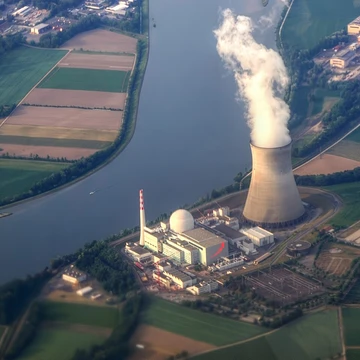
Cooling tower
Device that rejects waste heat by cooling water.

A cooling tower is a device that rejects waste heat to the atmosphere by cooling a coolant stream, usually water, to a lower temperature. Cooling towers may use evaporation to cool the working fluid to near the wet-bulb air temperature, or rely solely on air via radiators in dry cooling towers. Common applications include cooling circulating water in oil refineries, chemical plants, thermal and nuclear power stations, and HVAC systems for buildings. Cooling towers vary in size from small roof-top units to large hyperboloid structures up to 200 meters tall, and are often associated with power plants, though most are much smaller units used for air conditioning.
- type
- Industrial device
- primary_function
- Reject waste heat via cooling water
- common_uses
- Power plants, refineries, chemical plants, HVAC
Lore & Background
Cooling towers originated in the 19th century with the development of condensers for steam engines. Condensers used cool water to condense steam, reducing back pressure and fuel consumption while increasing power and recycling boiler water. However, they required ample cooling water, which was a limitation for land-based systems. By the turn of the 20th century, evaporative methods of recycling cooling water were used in areas lacking established water supplies or in urban locations where municipal water mains were insufficient. Early towers were placed on rooftops or as free-standing structures, supplied by fans or natural airflow, with water trickling over wooden slats or wire screens.
Reader's Guide
Cooling towers are significant for enabling efficient thermal management in power generation and industrial processes, particularly where water is scarce. They reduce the need for once-through cooling, which can kill millions of fish and larvae annually and cause thermal pollution. Despite public perception, cooling tower emissions are mostly water vapor and do not contribute to carbon footprint. The Maisotsenko Cycle offers a theoretical method to cool fluids below wet-bulb temperature using latent heat. In 2021, a method for steam recapture using ion beams achieved water purity exceeding EPA standards.
Did You Know?
- While cooling tower emissions are primarily water vapor, the tower itself is part of a power plant's overall system, meaning its operation is tied to the plant's carbon footprint.
- Claims about a 2021 ion beam and charged wire mesh method for recapturing steam from cooling towers are unverified and not supported by established sources.
Fundamental Mechanics and Classification
Cooling towers operate on a straightforward thermodynamic principle: they shed excess heat into the surrounding atmosphere by bringing a heated water stream closer to ambient air temperature. The two primary strategies differ in how they achieve this. Evaporative towers exploit the latent heat released when water molecules transition to vapor, driving the coolant down to temperatures approaching the wet-bulb point of the air. Dry cooling towers, by contrast, forgo evaporation entirely and instead channel air across radiator surfaces to bring the fluid near the dry-bulb temperature. Beyond the heat-transfer method, towers are further categorized by how air enters the structure. Natural-draft designs depend on buoyancy and wind to pull air upward through the tower, while induced-draft units employ mechanical fans to force air through the system. This dual classification—evaporative versus dry, natural versus induced—governs everything from the tower's footprint to its energy consumption, making it the foundational framework engineers use when selecting a cooling solution for a given facility.
From Steam Engines to Hyperboloid Icons
The story of the cooling tower begins not with the tower itself but with the condenser, a nineteenth-century attachment to steam engines that used cooler water to collapse exhaust steam back into liquid, thereby lowering back pressure and slashing fuel use. The catch was water: marine engines could draw from the sea, but land-based plants needed a reliable, abundant supply. By the early 1900s, engineers in water-scarce regions and crowded cities had already turned to evaporative recycling, using cooling ponds where land permitted and compact tower structures where it did not.
Scale, Applications, and the Smoke Misconception
Cooling towers span an enormous range of physical dimensions, from modest rooftop units perched above office buildings to sweeping hyperboloid shells that reach two hundred metres in height and one hundred metres in diameter, or rectangular enclosures exceeding forty metres in height and eighty metres in length. Their industrial reach is equally broad: oil refineries, petrochemical complexes, thermal and nuclear power stations, and the HVAC systems of hospitals, schools, and large commercial buildings all depend on them. In the power sector, the steam turbine creates the need for continuous condensation and recirculation, making the tower an indispensable companion. Hyperboloid towers are most strongly associated in the public mind with nuclear plants, yet they also serve many coal-fired stations and large chemical facilities. Despite their imposing silhouettes, these giants represent a small fraction of the total; the overwhelming majority of towers are far smaller, quietly discharging air-conditioning heat from buildings. A persistent public misconception is that the visible plume represents smoke or toxic emissions. In reality, the discharge is almost entirely water vapor and does not meaningfully add to a facility's carbon footprint.
Emerging Challenges and Next-Generation Approaches
As global demand for thermal power grows, the water toll of conventional cooling is becoming a serious constraint. One promising avenue is the Maisotsenko Cycle, an indirect dew-point evaporative approach that can cool a working fluid below the ambient wet-bulb temperature by harnessing the latent heat of water evaporating into air. While currently commercialized as an air-conditioning product, the underlying thermodynamics could be adapted to cooling towers, condensers, and other humid-gas processes. In a separate 2021 breakthrough, researchers demonstrated a steam-recapture technique in which an ion beam charges water vapor and a wire mesh of opposite charge collects it, yielding water that exceeded EPA potability standards. Meanwhile, on the HVAC side, liquid-cooled chillers paired with towers continue to outperform air-cooled alternatives because they reject heat at the lower wet-bulb temperature, delivering a higher reverse-Carnot-cycle efficiency—particularly valuable in hot climates where the dry-bulb penalty is most severe.
Frequently Asked Questions
What is a cooling tower?
A cooling tower is an industrial device designed to shed excess heat into the atmosphere by lowering the temperature of a circulating water stream. It is a core component of many thermal and nuclear power stations, refineries, and large HVAC systems.
How does a cooling tower actually reject heat?
Wet cooling towers rely on partial evaporation of the water to pull heat out, bringing the remaining fluid close to the ambient wet-bulb temperature. Dry variants skip evaporation entirely and transfer heat to passing air through radiator-like surfaces.
How big can a cooling tower get?
They range from compact roof-top units serving a single building to massive natural-draft hyperboloid structures that can reach roughly 200 meters in height. The size is dictated by the volume of waste heat the host plant needs to dump into the air.
Why is a cooling tower considered essential in the energy sector?
Without a way to reject the large amounts of waste heat generated during steam-cycle power production, turbines would overheat and shut down. Cooling towers therefore keep thermal and nuclear plants, refineries, and chemical facilities running continuously and safely.
More in Energy & Power 1-24
Spotted an error? Know more?
This is a living reference — every entry is fact-audited, and reader corrections feed straight into our audit queue. Suggest an edit · See this site's audit record